Florida Climate & Garage Floors
Why Standard Epoxy Fails in Florida Garages (And How Polyaspartic Solves Hot Tire Pickup)
Florida heat, humidity, moisture vapor, and hot tires can expose weaknesses in standard garage floor epoxy. Learn how professional polyaspartic systems are designed for Tampa Bay conditions.
The Florida Climate Dilemma: Why Concrete Acts Like a Sponge
Installing a custom floor coating is one of the most effective ways to transform a garage from a dusty storage zone into a clean, showroom-quality space. However, homeowners across Tampa Bay, St. Petersburg, and Clearwater sometimes discover a frustrating reality months after installation: the coating begins bubbling, yellowing, or peeling where vehicle tires sit.
Concrete is porous. Its microscopic capillaries and air pockets can allow moisture to move through the slab. In coastal and low-lying parts of Florida, ground moisture and humid conditions make moisture evaluation an important part of any garage floor coating project.
- Moisture can migrate upward through a concrete slab as moisture vapor transmission (MVT).
- Trapped moisture can contribute to hydrostatic pressure beneath an impermeable coating.
- A professional installation should evaluate the slab and use a system appropriate for its moisture conditions.
Moisture Vapor Transmission, Humidity, and UV Exposure
Florida garages face several environmental stress factors at once. Moisture vapor can move upward through the slab and become trapped beneath a dense coating. If the vapor pressure exceeds the bond strength, the coating can blister, bubble, or delaminate.
High humidity can also affect epoxy curing. Under unsuitable temperature, dew point, or moisture conditions, a waxy surface film known as amine blush may interfere with adhesion between coats. Strong sunlight is another concern: some epoxy formulations can amber or yellow when exposed to ultraviolet radiation over time.
- Moisture testing may include calcium chloride testing under ASTM F1869 or in-slab relative humidity testing under ASTM F2170.
- Temperature, humidity, dew point, ventilation, and cure time should be monitored during installation.
- A UV-stable aliphatic clear coat is often selected when long-term color stability is important.
What Is Hot-Tire Pickup?
Hot-tire pickup happens when warm tires bond to or pull up a coating as a vehicle leaves the garage. Florida highway surfaces can become extremely hot, transferring heat into the tires. If the coating softens or has inadequate adhesion, the tire can pull away flakes or patches when the vehicle moves.
Two forces are involved: heat can soften a coating, while the cooling tire can grip the surface and create mechanical tension. When the bond to the concrete is weak, the result may be bare, tire-shaped patches.
How Polyaspartic Technology Helps
Polyaspartic is an aliphatic polyurea coating technology used in demanding protective applications. In garage floor systems, it is commonly selected for fast return-to-service, UV stability, chemical resistance, and a durable clear topcoat.
A professional polyaspartic system can help address several common Florida garage concerns, but no coating can compensate for poor surface preparation or an unresolved moisture problem. Product specifications and installation procedures matter.
- Thermal resilience can reduce the risk of hot-tire pickup when the system is properly installed.
- Aliphatic chemistry provides strong resistance to yellowing from UV exposure compared with many standard epoxies.
- A properly selected system can provide better flexibility and impact resistance than a rigid coating used outside its intended conditions.
- Fast curing can allow homeowners to return to the garage sooner, subject to the manufacturer's cure schedule.
The Hybrid System Approach
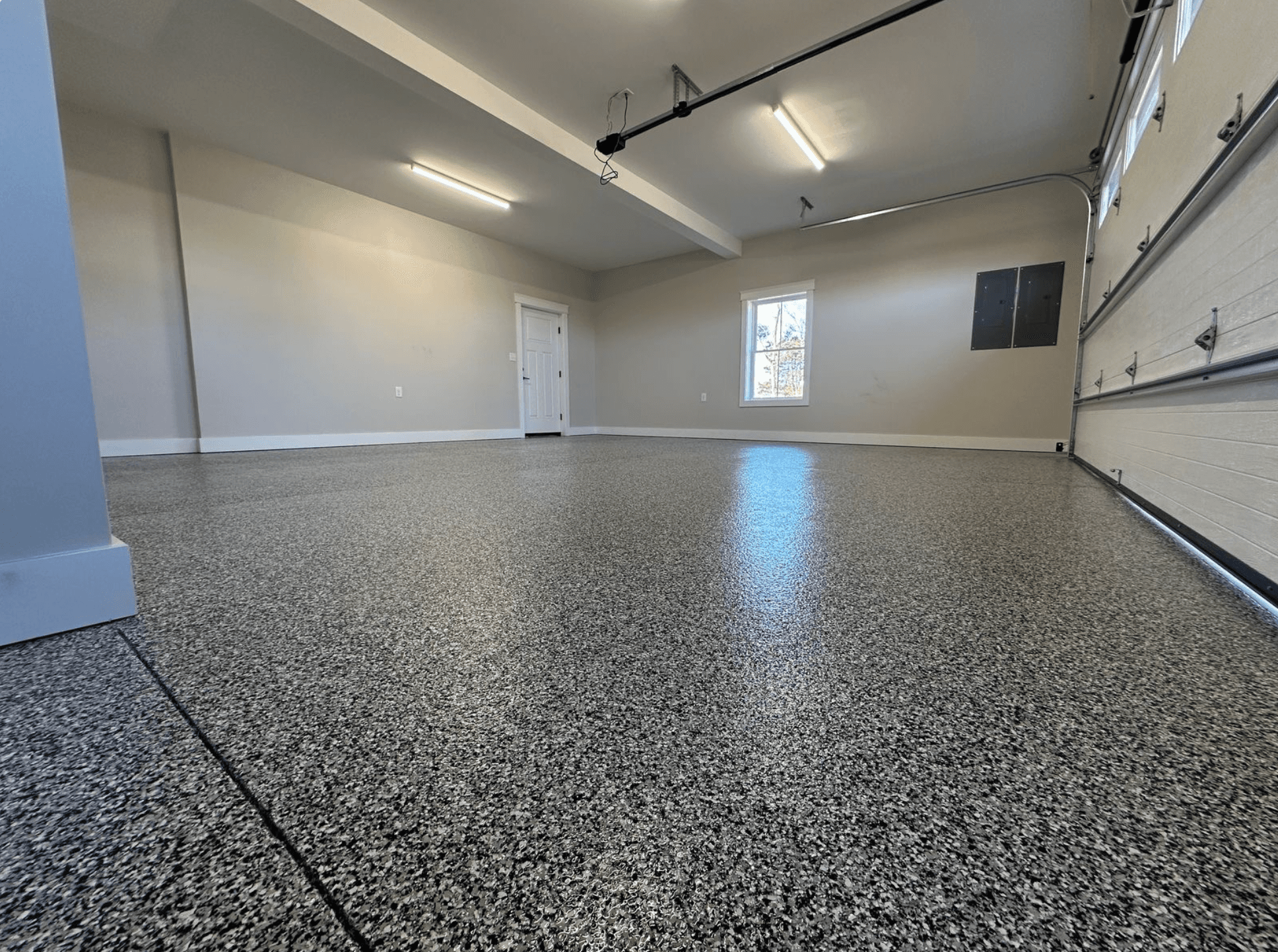
Many professional installations combine different layers so each one performs a specific job. A typical decorative flake system may use mechanically prepared concrete, a moisture-mitigating epoxy basecoat, a full flake broadcast, and a polyaspartic clear topcoat.
The exact products and layer thicknesses should be selected after inspecting the slab. A qualified installer should also follow the manufacturer's requirements for temperature, humidity, dew point, mixing, recoat windows, and cure time.
- Mechanically diamond-ground concrete creates a consistent surface profile and removes contaminants.
- A suitable basecoat bonds with the prepared concrete and helps manage the system's moisture requirements.
- A full decorative flake broadcast adds texture, visual depth, and slip resistance.
- A polyaspartic clear topcoat helps protect the floor from UV exposure, chemicals, oil, abrasion, and vehicle traffic.
Why Diamond Grinding Matters in Florida
Acid etching only affects the surface of concrete and may not remove coatings, curing compounds, grease, or other contaminants. It also introduces additional water into a slab that may already have moisture concerns.
Mechanical diamond grinding is a more controlled preparation method. It opens the surface profile, removes contaminants, and gives the coating system a clean, bondable substrate. The required concrete surface profile should be determined for the selected system and product specifications.
Frequently Asked Questions
- Can you put polyaspartic over existing garage floor epoxy? Usually, a failing coating should not simply be covered. The existing system may need to be mechanically removed or properly prepared down to a sound, well-bonded surface before a new system is installed.
- How long does a polyaspartic garage floor installation take? Many complete flake systems can be installed in one to two days, but walking and vehicle-return times depend on the product, weather, substrate, and manufacturer's instructions.
- Is acid etching enough preparation for Florida concrete? Acid etching may not be enough for a professional coating system. Mechanical preparation is often preferred because it removes contaminants and creates a more predictable surface profile.
Protect Your Investment with a Climate-Appropriate System
A garage floor coating should improve your home's appearance and function without becoming an annual repair project. The best results come from evaluating the concrete, managing moisture, selecting compatible products, and following a professional preparation and installation process.
Tampa Bay Concrete Coatings helps homeowners in Tampa, St. Petersburg, Clearwater, and surrounding communities choose coating systems suited to their project. Contact us for a free consultation and customized quote.
References and Industry Sources
International Concrete Repair Institute (ICRI), Guideline No. 310.2R: Selecting and Specifying Concrete Surface Preparation for Sealers, Coatings, and Polymer Overlays.
AMPP (formerly NACE International), standards and technical resources for corrosion control, polyurea/polyaspartic coatings, and concrete protection.
Concrete Construction, technical resources on moisture vapor emission in slabs-on-ground.
ASTM International, ASTM F1869: Standard Test Method for Measuring Moisture Vapor Emission Rate of Concrete Subfloor Using Anhydrous Calcium Chloride.
Garrett Allen
Owner & Lead InstallerGarrett Allen is the owner and lead installer at Tampa Bay Concrete Coatings. With over 20 years of hands-on experience, he has installed thousands of epoxy, polyaspartic, metallic resin, and polished concrete floors across Tampa, St. Petersburg, Clearwater, and the surrounding Tampa Bay communities.
- 20+ years in concrete coatings and surface preparation
- Specialist in Florida climate challenges: moisture vapor, UV exposure, and hot-tire pickup
- Diamond grinding, moisture testing, and premium system installation
- 15-year written warranty on professional installations
Ready to discuss your project?
Get practical recommendations and a free estimate from Tampa Bay Concrete Coatings.
You May Also Like
Cost & Buying Guides
DIY Epoxy Kits vs. Professional Diamond Grinding: Is Saving $1,000 Worth It?
Cost & Buying Guides
How Much Does Epoxy Flooring Cost in Tampa Bay? (2026 Price Breakdown)
Florida Climate & Moisture Testing